Last reviewed: May 2026
Your dog is always talking: are you listening?
Dogs communicate constantly through body language. Every wag of the tail, shift of the ears, and change in posture carries meaning. But the problem is that most humans are not fluent in dog, and we often misread what our dogs are telling us. Sometimes with serious consequences.
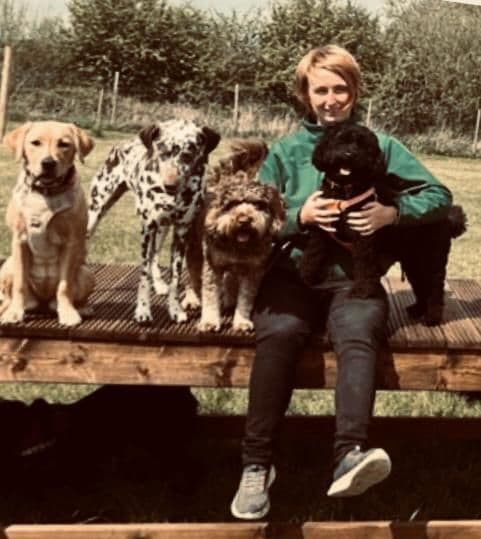
Learning to read your dog's body language is one of the most important things you can do as an owner. But it helps you spot stress before it escalates, understand when your dog is happy and relaxed, recognise when they need space, and respond appropriately in social situations. It also makes training more effective because you can read your dog's emotional state in real time and adjust your approach accordingly.
The tail: it is not just about wagging
The biggest misconception in dog body language is that a wagging tail means a happy dog. And it does not. It means an aroused dog. The tail is an indicator of emotional intensity, not emotional tone. The position, speed, and direction of the wag all matter.
One of the trainers in our directory worked with a dog-reactive Staffie for three months. The owner cried the first time they passed another dog without a meltdown.
- Relaxed, mid-height, gentle wag, a content, comfortable dog. You will recognise the easy, loose wag you see when your dog greets a familiar person calmly.
- High, stiff, fast wag: high arousal. This can be excitement, but it can also be intense focus or tension. Context matters. A dog wagging like this while stiffening their body and staring at another dog is not being friendly. They are on high alert.
- Low, slow wag: uncertainty or mild anxiety. Your dog is unsure about the situation and is gathering information.
- Tucked under the body: fear or extreme discomfort. Your dog is trying to make themselves small and non-threatening.
- Broad, full-body wag: genuine happiness and excitement. The whole rear end sways. It is the wag that greets you at the front door.
Breed matters too. Some breeds carry their tails naturally high (Huskies, Beagles) while others carry low (Greyhounds, Whippets). Learn what is normal for your dog's breed and watch for deviations from their baseline.
The ears
Ear position tells you a lot about what your dog is feeling:
We've written separately about loose lead walking if you want to read more.
- Neutral, relaxed position: calm and comfortable. Each breed has a different neutral. Floppy ears sit differently from pointed ears, so know your dog's baseline.
- Pricked forward: alert, interested, focused on something. Not necessarily negative, but combined with a stiff body, it can indicate intense focus on a trigger.
- Pinned back flat against the head: fear, anxiety, or appeasement. It ranks as one of the clearest stress signals and is easy to spot even in floppy-eared breeds.
- One ear forward, one back: processing conflicting information. Your dog is uncertain and trying to figure out the situation.
The eyes
A dog's eyes are remarkably expressive:
You might also find our post on stopping jumping up helpful.
- Soft, relaxed eyes: almond-shaped, partially closed, perhaps with a gentle squint. It is a relaxed, happy dog. You will see this during belly rubs and quiet cuddles.
- Hard stare: wide, round eyes fixed on something without blinking. You are looking at a dog who is highly focused and potentially about to react. A hard stare directed at another dog is a warning signal.
- Whale eye (half-moon eye), when you can see the whites of your dog's eyes in a crescent shape, usually because they are turning their head away from something while keeping their eyes fixed on it. Take it as a clear stress signal. You often see it when a dog is being hugged (most dogs do not enjoy hugs), when they are guarding a resource, or when they feel trapped.
- Averting gaze: deliberately looking away is a calming signal (more on those below). Your dog is trying to de-escalate a situation and communicate that they are not a threat.
The mouth
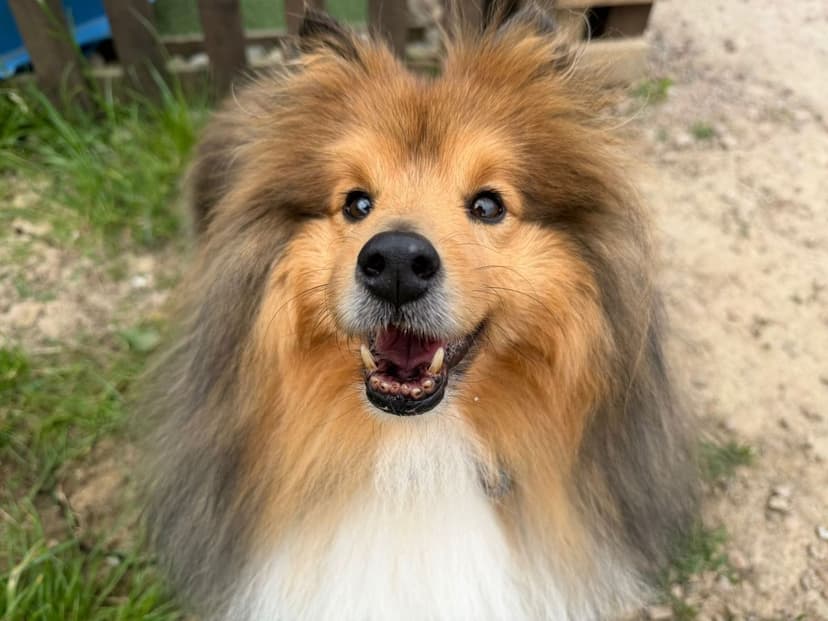
- Relaxed, slightly open mouth: comfortable and at ease. Some people call this the "dog smile" and while it is not a smile in the human sense, it does indicate relaxation.
- Closed, tight mouth: tension. A dog with a tightly closed mouth in a situation where they would normally be relaxed is likely stressed. It is subtle but important.
- Lip licking. Not after eating, but in response to a situation. Quick, repeated lip licks are a stress signal. You might see this at the vet, during grooming, or when a stranger reaches for your dog.
- Yawning, when not tired, a yawn is a calming signal that indicates stress or an attempt to de-escalate. Dogs often yawn during training when they are confused or feeling pressured.
- Showing teeth with a snarl. It is an unmistakable warning. The lips are pulled back to expose teeth, often accompanied by a wrinkled muzzle and a growl. Respect this signal, it is communication, not misbehaviour.
Posture: the whole body picture
Individual signals are useful, but the whole body tells the full story:
- Relaxed, loose body. A comfortable dog has a wiggly, loose posture. Weight is evenly distributed, muscles are not tense, and movements are fluid.
- Stiff, frozen body: tension and high arousal. A dog who suddenly freezes during play or while interacting with another dog is processing something and may be about to react. It is the moment to intervene.
- Weight shifted forward: confidence, interest, or potential confrontation. The dog is leaning into the situation.
- Weight shifted back or crouching: uncertainty or fear. The dog is preparing to retreat.
- Rolling over to expose belly. That does not mean always an invitation for belly rubs. In a social context with another dog, it can be an appeasement gesture. With a familiar, trusted human in a relaxed environment, it is usually a genuine request for affection. Look at the rest of the body, a relaxed, wiggly belly-up dog is happy; a stiff, still belly-up dog with whale eye is stressed.
Play signals versus stress signals
Play between dogs can look and sound alarming if you do not know what to look for. Start slow. Here is how to tell the difference:
Healthy play looks like
- Play bows (front end down, back end up). The universal "this is just a game" signal
- Role swapping, both dogs take turns being the chaser and the one being chased
- Self-handicapping. A bigger dog lying down or slowing down to let a smaller dog keep up
- Voluntary pauses: both dogs stop briefly, check in, then re-engage
- Bouncy, exaggerated movements. Play is over-the-top on purpose to signal it is not serious
Stress during play looks like
- One dog constantly trying to disengage while the other pursues
- No role swapping. One dog is always on top, always chasing, always pinning
- Stiff body, closed mouth, hard eyes, the intensity has shifted from playful to tense
- Yelping or freezing
- Tucked tail, pinned ears, attempts to hide
If you see stress signs during play, calmly interrupt and give both dogs a break. A secure dog field is a great place to practise supervised play between known dogs because you can control the environment completely.
Calming signals
Norwegian dog trainer Turid Rugaas identified a set of signals that dogs use to calm themselves and others. These are often subtle and easy to miss:
- Lip licking
- Yawning
- Turning the head away
- Turning the whole body away
- Sniffing the ground, when there is nothing obviously interesting to sniff
- Moving slowly
- Sitting or lying down: in a tense situation, choosing to be still
- Curving: approaching in a curve rather than head-on
When you see these signals, your dog is communicating. They may be telling another dog "I mean no harm", or they may be telling you "I am uncomfortable." Either way, pay attention and respect the message.
What to do when you see stress
The value of reading body language is in your response. We only recommend force-free trainers, and when you spot stress signals: Especially with puppies.
- Increase distance from the trigger. Move your dog away calmly.
- Do not force interaction. If your dog does not want to greet another dog or person, that is their choice.
- Provide an escape route. Never trap a stressed dog in a corner or on a short lead.
- Stay calm yourself. Your body language affects your dog's emotional state.
- Make a mental note. Patterns of stress help you identify triggers and avoid them or work on them with a professional trainer.
Why body language matters for training and socialising
Understanding body language transforms your approach to training. You can see when your dog is confused (slow down and simplify), when they are stressed (take a break), when they are engaged and ready to learn (push ahead), and when they have had enough (stop). This responsiveness builds trust and makes training more effective. No exceptions.
It is equally important during socialisation. Whether you are introducing a new puppy to an older dog, attending puppy classes, or visiting doggy day care, reading your dog's signals ensures every experience is positive rather than overwhelming.
Key takeaways
- A wagging tail does not always mean a happy dog, position, speed, and stiffness all matter.
- Whale eye, lip licking, and yawning (when not tired) are key stress signals to watch for.
- Healthy play involves role swapping, voluntary pauses, and bouncy movements.
- Calming signals are your dog's way of de-escalating: learn to spot and respect them.
- When you see stress, increase distance, do not force interaction, and stay calm.
- Body language fluency makes training, socialising, and everyday life with your dog significantly better.
Learn more about your dog
Understanding body language is the foundation of a great relationship with your dog. That matters. If you would like to develop these skills further, our training directory includes professionals who run body language workshops and behaviour consultations. For safe, supervised socialisation, explore our doggy day care and puppy day care programmes. And for private off-lead time to observe your dog at their most natural, book a dog field.
Written by the Wagtails team: qualified dog professionals based in Rettendon, Essex. We run 5-star licensed day care and three private dog parks, and we work with a network of trusted trainers, walkers, and groomers across the county.