Last reviewed: May 2026
Why a secure dog field is the ideal recall training environment
Recall is the single most important skill your dog can learn. But it keeps them safe, gives them freedom, and makes every walk more enjoyable for both of you. But building a reliable recall takes practice in a controlled environment before you can trust it in the real world, and that is exactly where a secure dog field comes in.
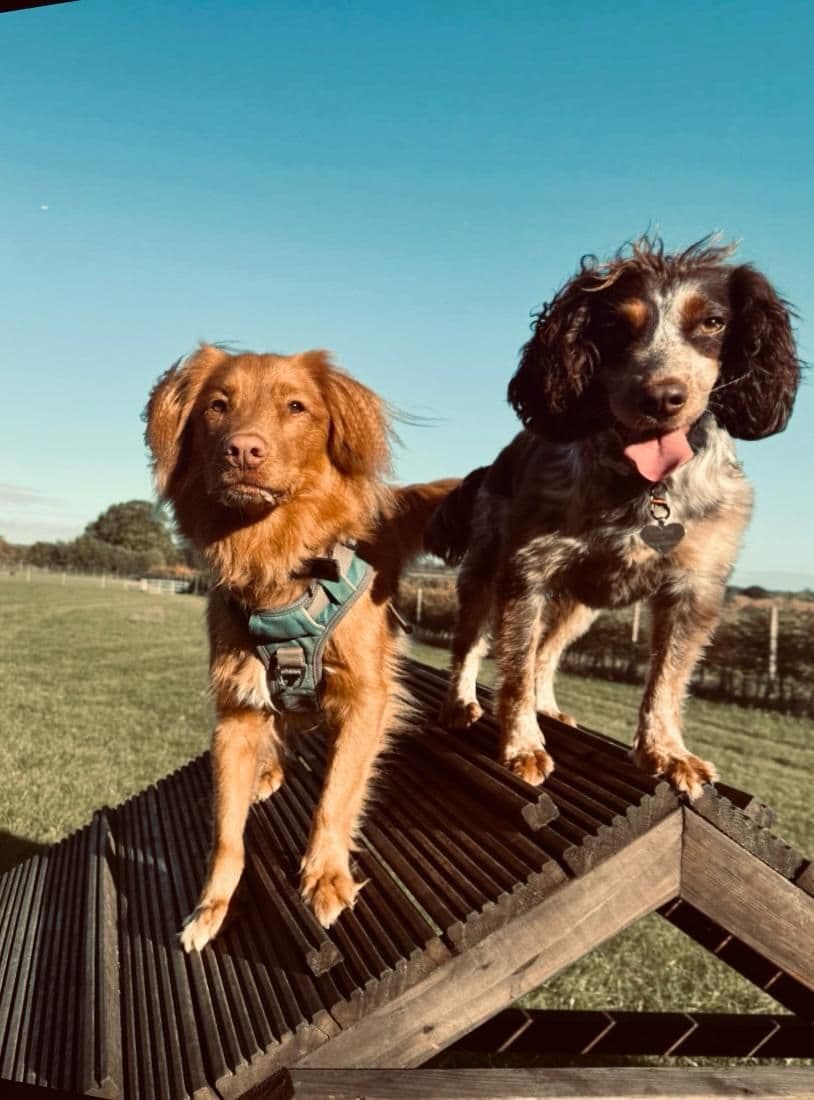
A fully enclosed field gives you space to work off-lead without the anxiety of your dog running into a road, approaching another dog, or disappearing over a hill. Trust takes time. And the fencing does the safety work so you can focus entirely on training. No distractions from other dogs (not as hard as it sounds). No well-meaning strangers offering treats. Just you, your dog, and the space to get it right.
At Wagtails dog fields, every field is enclosed with 6ft secure fencing and double-gated entry, which means you can unclip the lead the moment you step inside. In practice, it's the perfect setup for recall work at any stage. Whether you are starting from scratch with a puppy or rebuilding a recall that has broken down with an older dog.
Equipment you will need
You do not need much, but having the right kit makes a big difference:
We had a customer book our Rettendon field for a reactive German Shepherd who couldn't cope with other dogs. Six months of private field sessions later, he's now calm enough for group walks.
- High-value treats: small, soft, and smelly. Think cooked chicken, cheese, or commercial training treats. Kibble rarely cuts it when you are competing with the smells of a field.
- A treat pouch: keeps rewards accessible and your pockets clean.
- A long line (10-15 metres): useful for the first few sessions while you build confidence. Let it trail on the ground rather than holding it taut.
- A whistle (optional but recommended), a consistent sound that carries further than your voice. The Acme 211.5 is a popular choice for dog training.
- Your dog's favourite toy. Some dogs are more motivated by a quick game of tug than a treat. Use whatever gets the best response.
Warm-up exercises before you start recall
Jumping straight into recall drills the moment you arrive can backfire. And your dog has been in the car, they are excited about the new space, and their brain is in sniff-and-explore mode. Give them a few minutes to decompress and take in the environment before you ask for anything.
If you're also interested in activities for dog fields, many of the same ideas apply.
Let your dog have a free sniff around the field for 3-5 minutes. It's not wasted time. It helps them process the environment and settle into a calmer headspace. Once they have had a good explore, do a couple of easy exercises they already know well: a sit, a hand touch, or a simple game of find-it with treats scattered in the grass. This warms up their brain and reminds them that engaging with you is rewarding.
The recall sequence: building block by block
A reliable recall is built in layers. Timing matters. Rushing ahead too quickly is the number one reason recalls break down, so take your time with each stage.
Our guide to dog fields for reactive dogs covers some related ground.
Stage 1: Close-range engagement
Start with your dog just a few metres away. That matters. Say their name in a bright, happy tone. The moment they look at you, mark it (say "yes!" or click a clicker) and reward generously. Repeat this 10-15 times. You are not asking them to come to you yet, you are simply building the association that hearing their name means something brilliant is about to happen.
Stage 2: Introduce the recall cue
Once your dog is reliably turning towards you when they hear their name, add your recall word. This might be "come", "here", or a whistle pattern. Whatever you choose, keep it consistent. Call their name, then immediately give the recall cue. As they move towards you, encourage them with your body language (open arms, slight crouch, moving backwards). When they arrive, reward with 3-4 treats in a row, praise, and a quick game. Make arrival the best thing that happens all session.
Stage 3: Add movement and distance
Gradually increase the distance between you and your dog when you call. Start at 5 metres, then 10, then the full length of the field. Between recalls, let your dog go back to sniffing and exploring. You want them to learn that recall is not the end of fun, but a brief, rewarding interruption before they go back to what they were doing.
Stage 4: Add distractions
Once your dog is coming reliably at distance in a quiet field, start adding mild distractions. Our Cressing field is a favourite for this: it's big enough to really let a dog stretch its legs, and scatter a few treats on the ground and call them away from the scent trail. Toss a ball and recall them before they reach it. Bring a family member to stand in the field as a mild distraction. Build up slowly. The goal is to set your dog up to succeed at every stage. Without fail.
Distance and distraction progression
Think of recall reliability as a sliding scale with three variables: distance, duration, and distraction. When customers book one of our private fields, we always suggest when you increase one, dial back the others. If you are practising at the far end of the field (high distance), keep distractions low. If you are adding a new distraction (another person, a toy), keep the distance short. This prevents your dog from failing and ensures every recall attempt ends in success.
A good rule of thumb: your dog should be succeeding 8 out of 10 times at the current level before you make it harder. Watch closely. If their success rate drops below that, you have moved too fast. Step back to the previous level and build more repetitions there.
Common mistakes that wreck a recall
Even well-meaning owners make these errors. Being aware of them is half the battle:
- Only calling when it is time to leave: if recall always means fun is over, your dog learns to avoid it. Call them multiple times during a session, reward, and release them to play again.
- Repeating the cue: saying "come, come, come, COME!" teaches your dog that the first few times do not matter. Say it once. If they do not respond, go and get them rather than repeating yourself.
- Chasing your dog: running towards a dog who is not coming back turns it into a game. Instead, run away from them. Most dogs will instinctively chase you.
- Scolding on arrival. No matter how long it took them to come back, the moment they arrive must be positive. If you tell them off for being slow, you are telling them that coming to you is a bad idea.
- Skipping the reward: once your dog seems reliable, it is tempting to stop rewarding. But intermittent reinforcement (rewarding unpredictably rather than never) is what keeps behaviour strong long-term.
- Practising only in one place: dogs do not generalise well. A recall that works in your garden needs to be practised in the field, the park, the beach, and everywhere else you walk.
A 6-week recall progression plan
This plan assumes one or two 50-minute field sessions per week, plus short practice at home between sessions.
Weeks 1-2: Foundation
Focus on name recognition and close-range recalls (under 5 metres). Consistency is key. Use high-value treats every single time. Practise in the field and at home in the garden. Aim for 20-30 successful recalls per session. Keep sessions upbeat and short, if your dog loses focus, end on a success and take a break.
Weeks 3-4: Building distance
Increase recall distance to 10-20 metres. Introduce the whistle if you plan to use one (pair it with the verbal cue for a few sessions, then use it independently). Start calling your dog away from mild distractions, a sniff trail, a toy on the ground. Continue rewarding every recall generously.
Weeks 5-6: Proofing and real-world prep
Practise across the full length of the field. Add stronger distractions: a family member moving around, scattered treats, a toy throw. Begin varying your rewards: sometimes a treat, sometimes a game of tug, sometimes just enthusiastic praise and a release to go play. Start taking your improved recall to other environments (quiet parks, familiar walking routes) on a long line.
When to get professional help
If your dog shows no improvement after consistent practice, or if they are too anxious or overstimulated in the field to engage with you at all, it may be time to work with a professional. A qualified trainer can observe the dynamic between you and your dog and identify what is holding the recall back. Browse our dog training directory to find a force-free trainer in Essex, or explore our puppy training resources if you are starting with a young pup.
Key takeaways
- A secure dog field removes the variables that make recall training in public spaces stressful and risky.
- Build recall in stages. Name recognition, then the cue, then distance, then distractions.
- Your dog should succeed 8 out of 10 times before you make it harder.
- Never scold a dog for coming back slowly. Arrival must always be rewarded.
- Consistency and patience over 6 weeks will produce dramatic results.
Book a field and start training
Our secure dog fields in Essex are purpose-built for exactly this kind of training. With 6ft fencing, double-gated entry, and 50 minutes of uninterrupted private access, you have everything you need to build a recall you can trust. Find your nearest field and book online today. If you would like help finding a trainer to work alongside, get in touch. We are always happy to help. Even on rainy days.
Written by the Wagtails team: qualified dog professionals based in Rettendon, Essex. We run 5-star licensed day care and three private dog parks, and we work with a network of trusted trainers, walkers, and groomers across the county.