Last reviewed: May 2026
Why choosing the right day care matters
Leaving your dog in someone else's care is a big decision. But the right day care gives your dog a safe, stimulating environment where they can socialise, exercise, and rest under the watchful eye of qualified staff. The wrong one can leave your dog stressed, anxious, or even injured. With more day care providers popping up every year across Essex, it has never been more important to know what separates a genuinely good facility from one that simply looks the part on social media.

This guide walks you through everything you need to consider before booking a trial day, from licensing and insurance to group sizes, daily routines, and the questions that will tell you the most about how a provider actually operates.
Start with licensing and insurance
In England, any business that provides day care for dogs must hold a valid animal activities licence issued by the local council under the Animal Welfare (Licensing of Activities Involving Animals) (England) Regulations 2018. It's not optional. But it is a legal requirement, and any provider operating without one is breaking the law.
One of our day care regulars, a young Labrador, was so nervous on his first day he hid under a bench. Within a week he was leading the pack around the yard.
A licensed facility has been inspected by the local authority and meets minimum standards for housing, record-keeping, emergency procedures, and animal welfare. But the licence should be displayed publicly, and you should be able to verify it with your local council if you have any doubts.
Beyond the licence, check that the provider has appropriate insurance. This should include public liability insurance and care, custody, and control cover. If a dog is injured in their care or causes damage, insurance protects everyone involved. Do not be afraid to ask to see copies of their documentation. A reputable provider will be happy to show you.
Staff qualifications and ratios
The people looking after your dog matter enormously. Our team always recommends ask what qualifications the staff hold. Look for recognised certifications in canine behaviour, first aid for dogs, and animal care. Experience counts too, but formal training shows a commitment to professional standards and up-to-date knowledge.
There's more on this in our guide to what happens at day care.
Staff-to-dog ratios are one of the most important indicators of quality. A ratio of one member of staff to six dogs is widely considered a good benchmark for supervised group care. Some providers stretch this to one-to-ten or even higher, which makes it very difficult to manage behaviour, spot early signs of stress, and intervene before problems escalate.
Ask how staff are trained to read canine body language. Can they tell the difference between play and a dog that is becoming overwhelmed? Do they know when to separate dogs and give them a break? These are the skills that prevent incidents and keep every dog feeling safe.
Questions worth asking about staff
- How many staff members are present during a typical session?
- What qualifications do your handlers hold?
- Do you have a canine first aider on site at all times?
- How do you handle a dog that is showing signs of stress?
- What is your protocol if a dog fight occurs?
Group sizes and how dogs are managed
The total number of dogs in a session matters just as much as the staff ratio. A facility with 30 dogs and five handlers may technically have a decent ratio, but 30 dogs together in one space creates a very different dynamic to three groups of ten in separate areas.
We've written separately about whether day care is worth it if you want to read more.
Good day care providers separate dogs into smaller groups based on size, temperament, energy level, and play style. A tiny Chihuahua should not be sharing open space with a boisterous young Labrador, no matter how friendly either dog is. Size differences alone create risk, and mixing very different energy levels leads to frustration and conflict.
Ask how dogs are assessed before being placed into a group. The best providers carry out a thorough temperament assessment during a trial session, watching how your dog interacts with different types of dogs and adjusting group placement accordingly. That's not a one-off process either. As dogs settle in and their confidence changes, good providers reassess and move dogs between groups when needed.
The facility itself
Visit in person before you commit. Small steps. Any provider worth their salt will welcome a visit and be happy to show you around. If they refuse, or only offer to show you the reception area, walk away.
What to look for inside
- Cleanliness. The space should smell clean (not of bleach, which can mask poor hygiene, but genuinely clean). Floors should be non-slip and easy to sanitise.
- Secure boundaries: double-gated entry and exit points prevent escape. Fencing should be tall enough and in good condition.
- Rest areas: dogs need downtime. Look for quiet spaces with comfortable bedding away from the main play area. A day care that runs dogs all day with no rest is not doing them any favours.
- Fresh water: available at all times, in multiple locations.
- Outdoor space: access to secure outdoor areas for toileting and fresh air is essential. Dogs should not be cooped up inside all day.
- Temperature control: adequate ventilation in summer and heating in winter. Dogs can overheat quickly in poorly ventilated spaces.
- CCTV: many good providers have cameras for monitoring. Some even offer live feeds so you can check in on your dog during the day.
What to look for outside
- Secure, double-fenced perimeter with no gaps or weak points
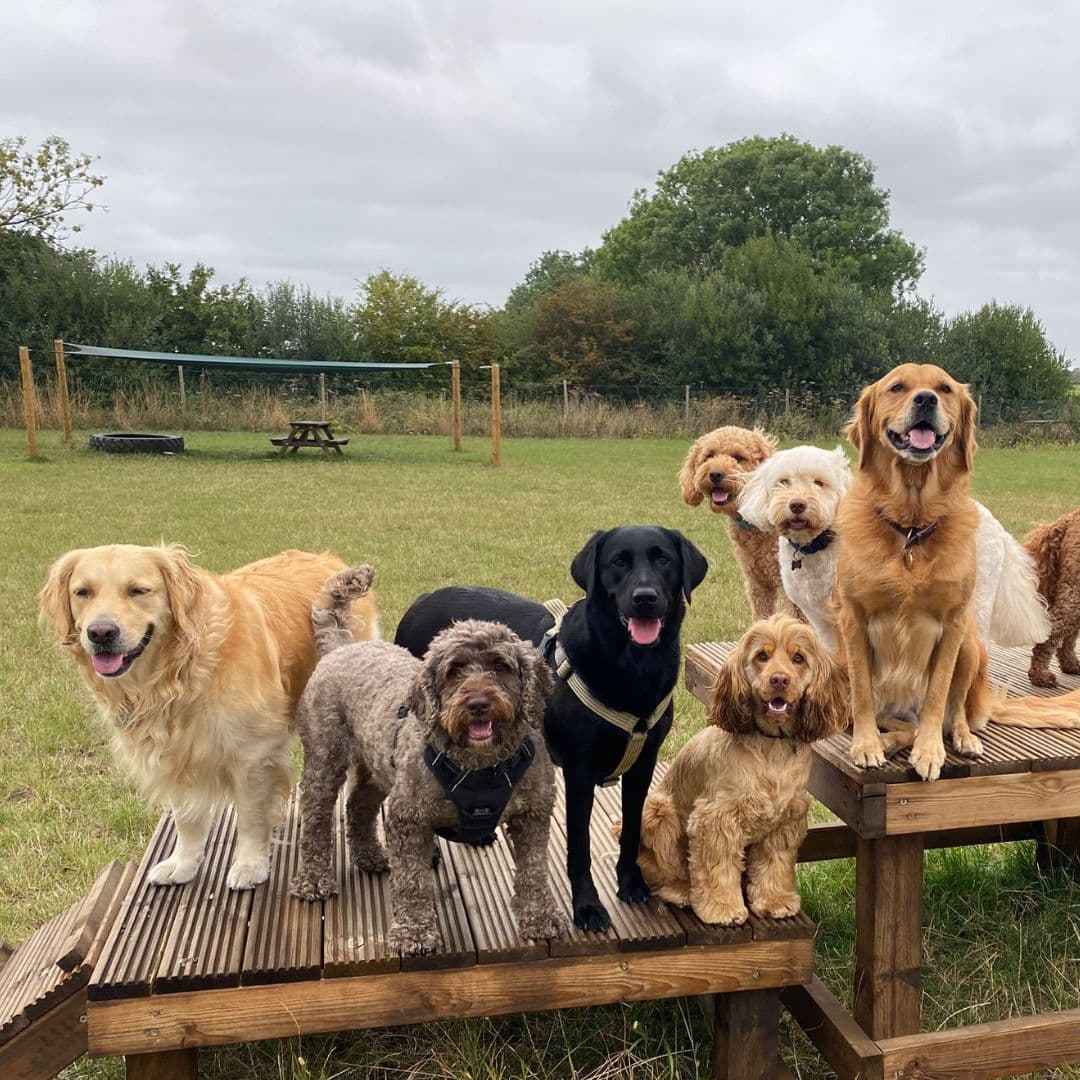
- Shade and shelter from rain and sun
- Clean ground surfaces with good drainage
- Separate areas for different groups
The daily routine
Structure matters for dogs. A good day care runs to a predictable daily routine that balances active play, enrichment, rest, and toileting breaks. Ask what a typical day looks like from drop-off to collection.
Here is what a well-structured day might include:
- Morning arrival and settling in. A calm handover where staff check each dog and allow them to settle at their own pace
- Morning play session: supervised group play or structured activities
- Mid-morning enrichment: puzzle feeders, scent work, or gentle training exercises to keep minds busy
- Lunchtime rest: enforced quiet time for napping and recharging. This is essential, especially for younger dogs who do not know when to stop
- Afternoon play, a second play session, often slightly calmer than the morning
- Wind-down: relaxation time before collection so dogs go home settled rather than wired
If a provider cannot describe their routine, or their answer boils down to "the dogs just play all day", that is a concern. Timing matters. Dogs that play non-stop become over-stimulated and exhausted, which can lead to behavioural issues and a dog that comes home completely unable to settle. Rain or shine.
Trial days and the assessment process
Never commit to regular day care without a trial day first. A reputable provider will insist on one. The trial serves two purposes: it lets the staff assess whether your dog is a good fit for their environment, and it lets you assess whether the provider is a good fit for your dog.
During the trial, staff should be watching for how your dog responds to the space, the other dogs, the noise, and the routine. Keep it simple. They should communicate honestly with you afterwards, including if they think day care might not be the right option for your dog right now. Not every dog thrives in a group setting, and a provider who is willing to say that is one you can trust.
At Wagtails Day Care, every dog goes through a structured meet-and-greet process before their first full day. We assess temperament, play style, and energy level to make sure we place your dog in the right group from the start. If we think your dog needs a more gradual introduction, we will tell you and work with you on a plan.

Red flags to watch out for
Some warning signs should end your search immediately:
- No licence displayed or available: non-negotiable. Walk away.
- Reluctance to show you around: if they will not let you see where your dog will spend the day, something is wrong.
- No trial or assessment process. A provider that accepts any dog without checking suitability is putting every dog at risk.
- Overcrowding: too many dogs for the space or too few staff to manage them safely.
- No rest periods: dogs need downtime. All play and no rest is not enriching; it is exhausting.
- Poor communication. You should know how your dog's day went. Photos, updates, and honest feedback are the bare minimum.
- No vaccination requirements, a provider that does not check vaccination records is risking the health of every dog in their care.
- Punitive methods: any mention of physical aversive techniques, spray bottles, rattle cans, or other aversive tools. Modern day care uses positive reinforcement only.
What about puppies?
If you have a puppy, the considerations are slightly different. Puppies have developing immune systems, shorter attention spans, and very different socialisation needs compared to adult dogs. Not every day care is set up to cater to them properly.
Look for a provider that runs dedicated puppy day care sessions with age-appropriate activities, shorter days, more rest time, and handling by staff who understand puppy development stages. It adds up. A good puppy day care supports the critical socialisation window without overwhelming a young dog.
Questions to ask before you book
Here is a checklist of questions to take with you when you visit a prospective day care:
- Are you licensed by the local council? Can I see the licence?
- What insurance do you carry?
- What is your staff-to-dog ratio?
- How are dogs grouped and assessed?
- What does a typical day look like?
- How do you handle dogs that are not coping?
- What is your emergency vet procedure?
- Do you require proof of vaccinations?
- Can I visit and see the facility before booking?
- What feedback will I receive about my dog's day?
Key takeaways
- Always check for a valid animal activities licence and insurance
- Look for staff-to-dog ratios of around one to six and ask about qualifications
- Dogs should be separated into groups by size, temperament, and energy level
- A structured daily routine with enforced rest periods is essential
- Visit the facility in person and trust your instincts
- A trial day should be mandatory, not optional
- Red flags include no licence, no assessment, overcrowding, and poor communication
Ready to find the right day care?
At Wagtails, we are a licensed, insured, family-run day care in Essex with small group sizes, qualified staff, and a genuine commitment to every dog's wellbeing. We would love to show you around and talk through how we can support your dog.
Get in touch to arrange a visit, or learn more about our doggy day care and puppy day care services. Especially with puppies.
Written by the Wagtails team: qualified dog professionals based in Rettendon, Essex. We run 5-star licensed day care and three private dog parks, and we work with a network of trusted trainers, walkers, and groomers across the county.